Home > Comparison > Technology > AMD vs IPGP
The strategic rivalry between Advanced Micro Devices, Inc. (AMD) and IPG Photonics Corporation shapes the semiconductor industry’s innovation frontier. AMD operates as a diversified semiconductor powerhouse, focusing on computing and graphics processors. In contrast, IPG Photonics specializes in high-performance fiber lasers and amplifiers, targeting niche industrial applications. This analysis probes which distinct operational model delivers superior risk-adjusted returns, guiding investors seeking balanced exposure within the technology sector.

Table of contents
Companies Overview
Advanced Micro Devices and IPG Photonics stand as pivotal innovators in the semiconductor industry, each commanding unique market niches.
Advanced Micro Devices, Inc.: Semiconductor Powerhouse
Advanced Micro Devices dominates the semiconductor space with its high-performance processors and graphics units. It generates revenue primarily from CPUs and GPUs for personal computers, servers, and game consoles. In 2026, AMD sharpened its strategic focus on expanding its data center processor market and enhancing its semi-custom SoC offerings, solidifying its competitive edge in computing and graphics.
IPG Photonics Corporation: Fiber Laser Specialist
IPG Photonics leads in high-power fiber laser technology used for materials processing and telecommunications. Its revenue hinges on selling fiber lasers, amplifiers, and integrated laser systems globally. Recently, IPG prioritized advancing specialized fiber laser systems and expanding its presence in medical and communications sectors, emphasizing innovation in laser applications.
Strategic Collision: Similarities & Divergences
Both companies excel in semiconductor-driven innovation but diverge sharply in their market approaches—AMD focuses on broad computing ecosystems, while IPG pursues niche laser and photonics technologies. Their primary battleground lies in technological leadership within their segments rather than direct market overlap. Investors face distinct profiles: AMD offers scale and diversification, while IPG presents specialized growth in advanced laser solutions.
Income Statement Comparison
This data dissects the core profitability and scalability of both corporate engines to reveal who dominates the bottom line:
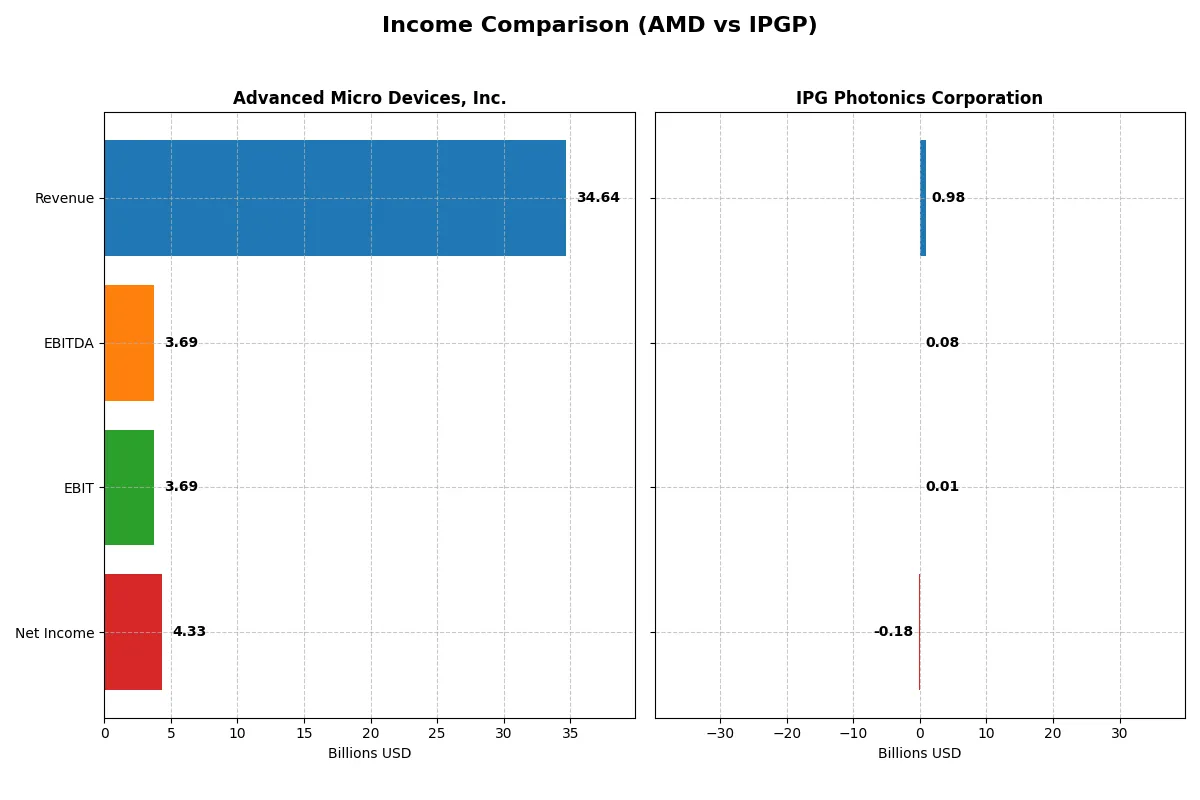
| Metric | Advanced Micro Devices, Inc. (AMD) | IPG Photonics Corporation (IPGP) |
|---|---|---|
| Revenue | 34.6B | 977M |
| Cost of Revenue | 17.5B | 639M |
| Operating Expenses | 13.5B | 546M |
| Gross Profit | 17.2B | 338M |
| EBITDA | 3.7B | 76M |
| EBIT | 3.7B | 14M |
| Interest Expense | 131M | 0 |
| Net Income | 4.3B | -182M |
| EPS | 2.67 | -4.09 |
| Fiscal Year | 2025 | 2024 |
Income Statement Analysis: The Bottom-Line Duel
This income statement comparison reveals which company converts sales into profit most efficiently, spotlighting their corporate engines’ true strength.
Advanced Micro Devices, Inc. Analysis
AMD’s revenue surged from $16.4B in 2021 to $34.6B in 2025, showing robust growth. Net income rose sharply to $4.3B in 2025, doubling over one year. Gross margin remains healthy near 50%, and net margin expanded to 12.5%, reflecting strong operational efficiency and superior cost control.
IPG Photonics Corporation Analysis
IPGP’s revenue declined from $1.46B in 2021 to $977M in 2024, signaling contraction. Net income swung from positive $278M in 2021 to a loss of $182M in 2024. Gross margin dropped to 34.6%, and net margin turned negative at -18.6%, indicating operational challenges and diminishing profitability momentum.
Margin Strength vs. Revenue Expansion
AMD clearly outperforms IPGP in both scale and profitability, with a doubling of revenue and net income growth amid expanding margins. IPGP faces shrinking revenue and deepening losses. For investors, AMD’s profile offers a compelling combination of growth and margin resilience, while IPGP’s struggles warrant caution.
Financial Ratios Comparison
These vital ratios act as a diagnostic tool to expose the underlying fiscal health, valuation premiums, and capital efficiency of the companies compared below:
| Ratios | Advanced Micro Devices, Inc. (AMD) | IPG Photonics Corporation (IPGP) |
|---|---|---|
| ROE | 2.85% (2024) | -8.97% (2024) |
| ROIC | 2.49% (2024) | -9.97% (2024) |
| P/E | 124 (2024) | -18 (2024) |
| P/B | 3.52 (2024) | 1.59 (2024) |
| Current Ratio | 2.62 (2024) | 6.98 (2024) |
| Quick Ratio | 1.83 (2024) | 5.59 (2024) |
| D/E | 0.04 (2024) | 0.01 (2024) |
| Debt-to-Assets | 3.20% (2024) | 0.78% (2024) |
| Interest Coverage | 20.7 (2024) | 0 (2024) |
| Asset Turnover | 0.37 (2024) | 0.43 (2024) |
| Fixed Asset Turnover | 10.63 (2024) | 1.66 (2024) |
| Payout ratio | 0% (2024) | 0% (2024) |
| Dividend yield | 0% (2024) | 0% (2024) |
| Fiscal Year | 2024 | 2024 |
Efficiency & Valuation Duel: The Vital Signs
Financial ratios act as a company’s DNA, exposing hidden risks and operational strengths critical for investment decisions.
Advanced Micro Devices, Inc.
AMD posts a favorable net margin of 12.51%, but its ROE and ROIC register at zero, signaling weak profitability. The stock trades at a stretched P/E of 80.54, suggesting high valuation risk. AMD offers no dividends, instead reinvesting heavily in R&D, dedicating 25% of revenue to innovation and growth.
IPG Photonics Corporation
IPGP suffers negative profitability with a net margin of -18.58% and a ROE of -8.97%, reflecting operational challenges. Its P/E ratio is negative but marked favorable due to valuation norms in distress. The company pays no dividend and focuses on maintaining a strong liquidity buffer with a current ratio near 7 and reinvests cautiously amid losses.
Premium Valuation vs. Operational Safety
AMD’s high valuation contrasts with IPGP’s financial strain and operational losses. AMD’s reinvestment in R&D points to growth potential, while IPGP’s liquidity cushions risks. Investors favoring growth may lean toward AMD, whereas risk-averse profiles might consider IPGP’s defensive liquidity stance.
Which one offers the Superior Shareholder Reward?
Advanced Micro Devices (AMD) and IPG Photonics Corporation (IPGP) both forgo dividends, focusing shareholder rewards on capital appreciation and buybacks. AMD’s payout strategy relies heavily on aggressive share repurchases fueled by strong free cash flow of 3.4B in 2025 and a payout ratio of zero, preserving capital for reinvestment in R&D and growth. IPGP, despite a negative net margin in 2024, maintains a robust share buyback program supported by free cash flow of 3.4B and a conservative capital expenditure profile. Historically, AMD’s high P/E of 80x signals growth expectations but also valuation risk. IPGP trades at a more reasonable multiple around 21x free cash flow, balancing growth with valuation. I find AMD’s buyback-driven reward more sustainable long-term given its superior operating margins and cash flow coverage. For 2026, I favor AMD for superior total shareholder return potential, supported by stronger fundamentals and disciplined capital allocation.
Comparative Score Analysis: The Strategic Profile
The radar chart reveals the fundamental DNA and trade-offs of Advanced Micro Devices, Inc. (AMD) and IPG Photonics Corporation (IPGP):
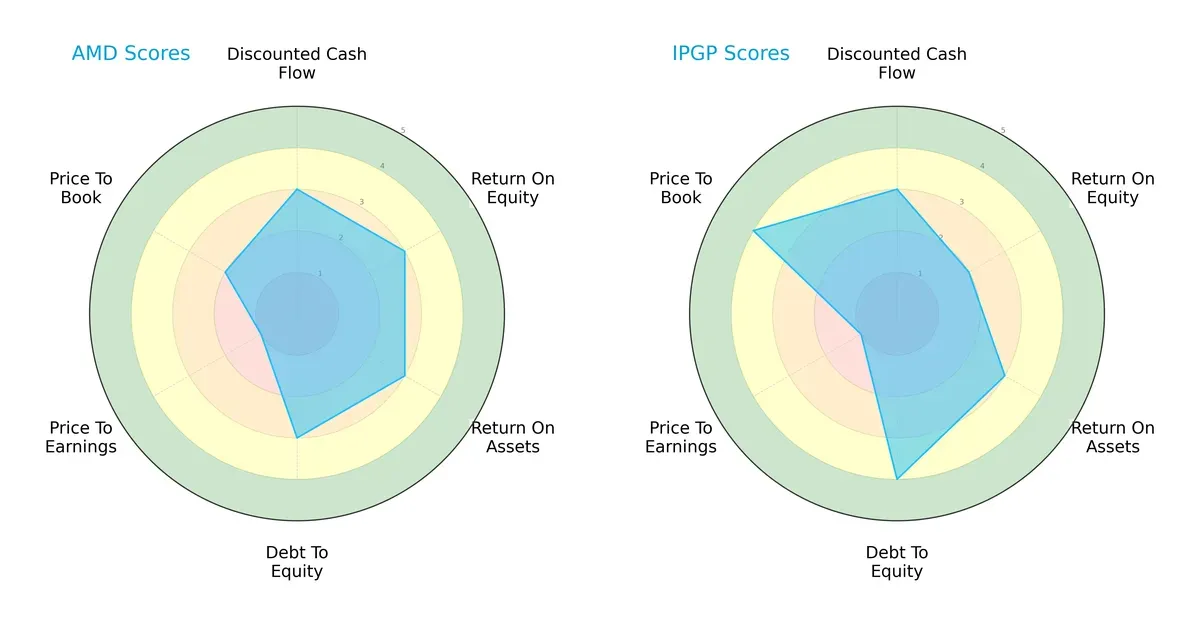
AMD shows a balanced strength in profitability (ROE 3) and asset utilization (ROA 3), matching IPGP’s asset efficiency but exceeding it in equity returns. IPGP leads on debt management (4 vs. 3) and valuation (P/B 4 vs. 2), highlighting its conservative financial structure. AMD’s weaker P/E score (1) signals potential overvaluation risk. Overall, AMD relies on operational efficiency, while IPGP leverages financial prudence and valuation discipline.
Bankruptcy Risk: Solvency Showdown
The Altman Z-Scores position both firms securely in the safe zone, with AMD at 18.0 and IPGP at 11.7, underscoring their robust solvency in this cycle:
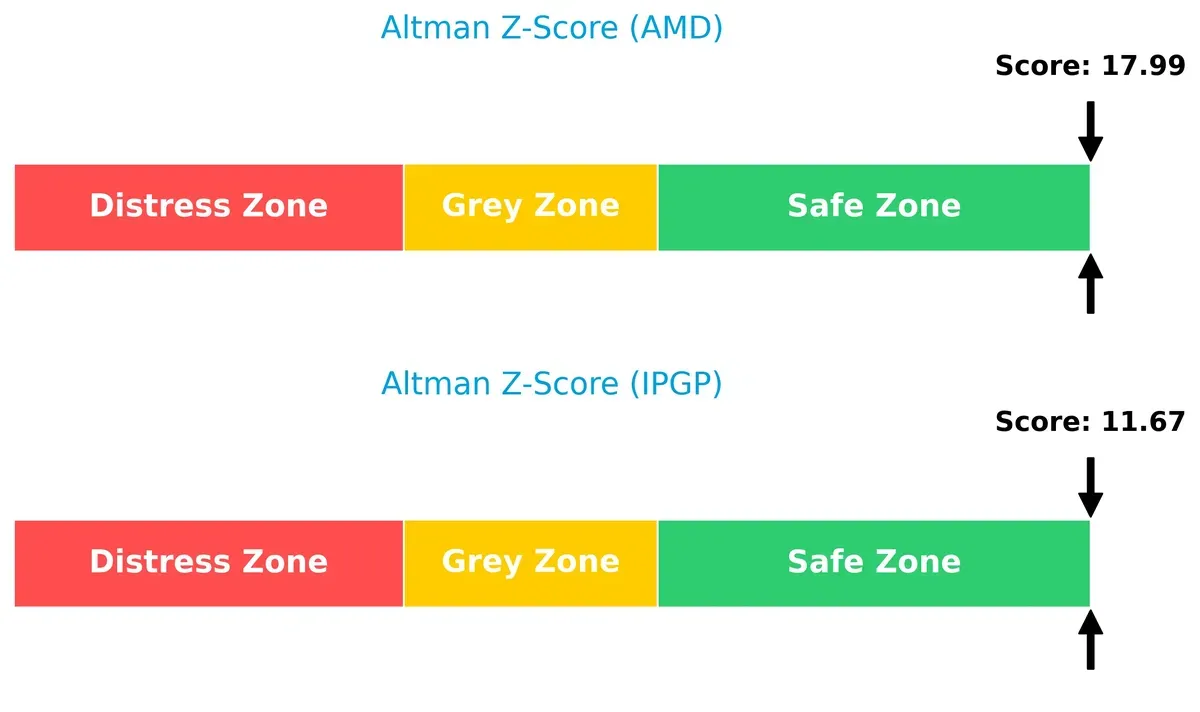
AMD’s extraordinarily high Z-Score reflects exceptional financial resilience and low bankruptcy risk, likely due to strong cash flows and capital structure. IPGP, while also safe, shows a more moderate buffer, signaling solid but less dominant solvency.
Financial Health: Quality of Operations
Both AMD and IPGP score a strong 7 on the Piotroski F-Score, indicating robust internal financial health and operational quality:
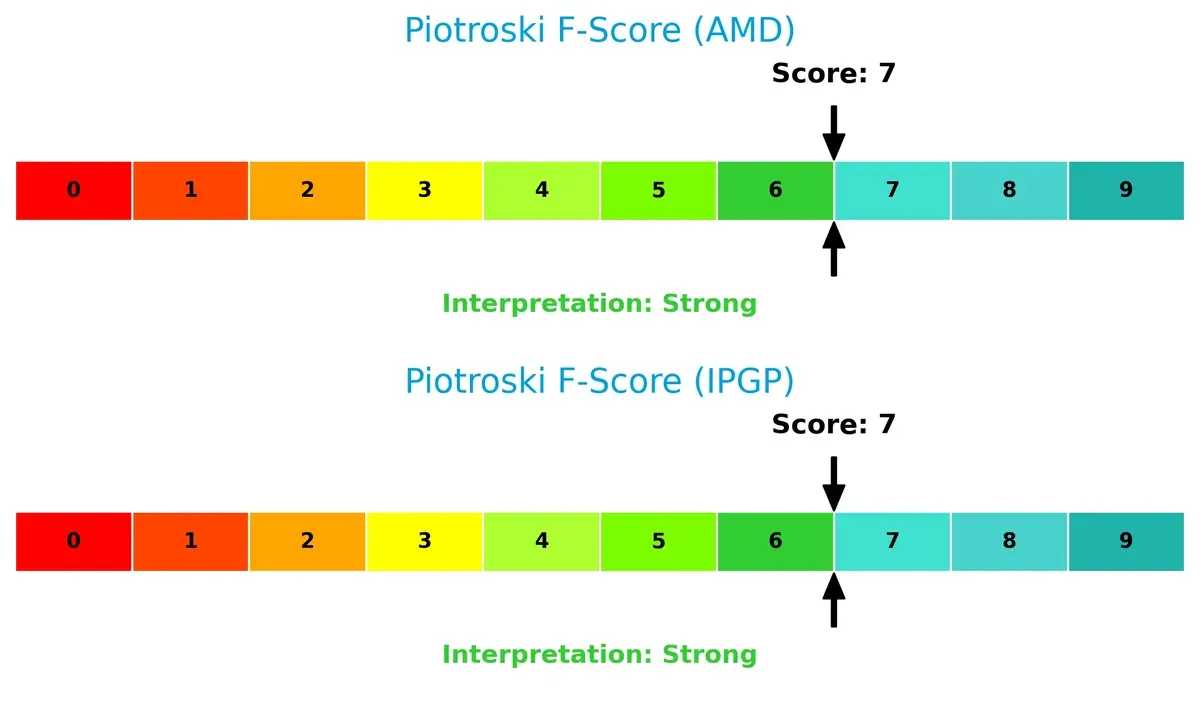
These scores suggest both companies maintain efficient profitability, liquidity, and leverage management. No glaring red flags appear, confirming these stocks as fundamentally sound choices for investors seeking quality.
How are the two companies positioned?
This section dissects AMD and IPGP’s operational DNA by comparing their revenue distribution by segment and analyzing their strengths and weaknesses. The goal is to confront their economic moats and reveal which model offers the most resilient, sustainable competitive advantage today.
Revenue Segmentation: The Strategic Mix
This visual comparison dissects how Advanced Micro Devices, Inc. and IPG Photonics Corporation diversify their income streams and where their primary sector bets lie:
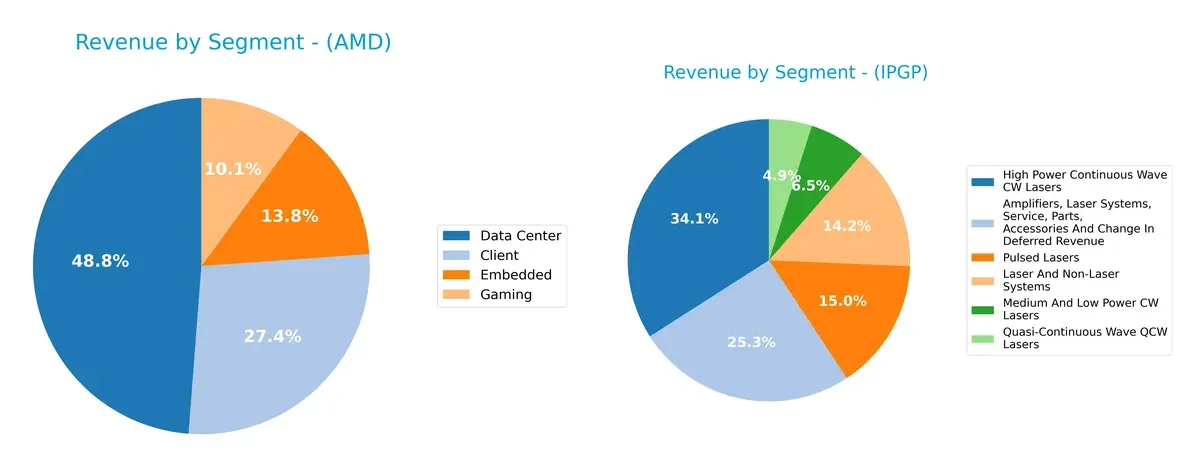
AMD’s revenue anchors on the Data Center segment at $12.6B, dwarfing other segments like Client ($7.1B) and Embedded ($3.6B). This concentration highlights AMD’s strategic pivot towards cloud infrastructure dominance. In contrast, IPG Photonics spreads revenue more evenly, with High Power Continuous Wave CW Lasers leading at $333M and Amplifiers and Services contributing $247M. IPG’s diversified laser portfolio mitigates concentration risk, unlike AMD’s reliance on a single dominant segment.
Strengths and Weaknesses Comparison
This table compares the Strengths and Weaknesses of AMD and IPGP based on diversification, profitability, financials, innovation, global presence, and market share:
AMD Strengths
- Diverse product segments including Client, Data Center, Embedded, Gaming
- Strong net margin at 12.51%
- Favorable debt-to-assets and interest coverage ratios
- Large global footprint with significant U.S. and China sales
IPGP Strengths
- Favorable quick ratio and low debt-to-assets indicating strong liquidity and low leverage
- Positive interest coverage with infinite value
- Product focus on lasers and amplifiers with niche specialization
- Geographic sales diversified across North America, Europe, and Asia
AMD Weaknesses
- Unfavorable ROE and ROIC indicating weak capital efficiency
- High WACC at 12.94% exceeding ROIC
- Poor liquidity ratios with zero current and quick ratios
- Very high PE ratio at 80.54 signaling expensive valuation
- Asset turnover ratios unfavorable, suggesting low operational efficiency
IPGP Weaknesses
- Negative net margin and returns (ROE, ROIC) reflecting unprofitability
- High current ratio may indicate inefficient asset use
- Negative PE ratio complicates valuation
- Asset turnover low and fixed asset turnover only neutral
- No dividend yield, limiting income appeal
Both companies exhibit strengths in specific niches and financial areas but face significant weaknesses in profitability and operational efficiency. AMD’s strong product diversification contrasts with IPGP’s liquidity and low leverage. These factors shape their strategic challenges and opportunities in competitive markets.
The Moat Duel: Analyzing Competitive Defensibility
A structural moat is the critical shield protecting long-term profits from relentless competitive pressure and market disruption:
Advanced Micro Devices, Inc. (AMD): Innovation-Driven Technology Moat
AMD’s moat stems from cutting-edge product innovation and ecosystem integration. Its strong gross margin (49.5%) signals pricing power and cost efficiency. However, declining ROIC warns of eroding capital efficiency. New data center GPUs and AI chips could reinforce AMD’s moat in 2026.
IPG Photonics Corporation (IPGP): Specialized Laser Technology Moat
IPGP relies on proprietary fiber laser technology and high entry barriers. Compared to AMD, its moat is narrower, reflected by a weaker EBIT margin (~1.5%) and negative net margins. The shrinking revenue base challenges moat durability, though emerging applications in materials processing offer greenfield growth potential.
Verdict: Innovation Scale vs. Niche Specialization Moats
AMD possesses a wider moat driven by scale, innovation, and superior margin resilience. IPGP’s moat is narrower and under pressure from declining profitability. AMD is better positioned to defend its market share amid intensifying semiconductor competition.
Which stock offers better returns?
The past year shows pronounced bullish momentum for both stocks, with Advanced Micro Devices surging strongly and IPG Photonics posting solid gains amid accelerating trends.
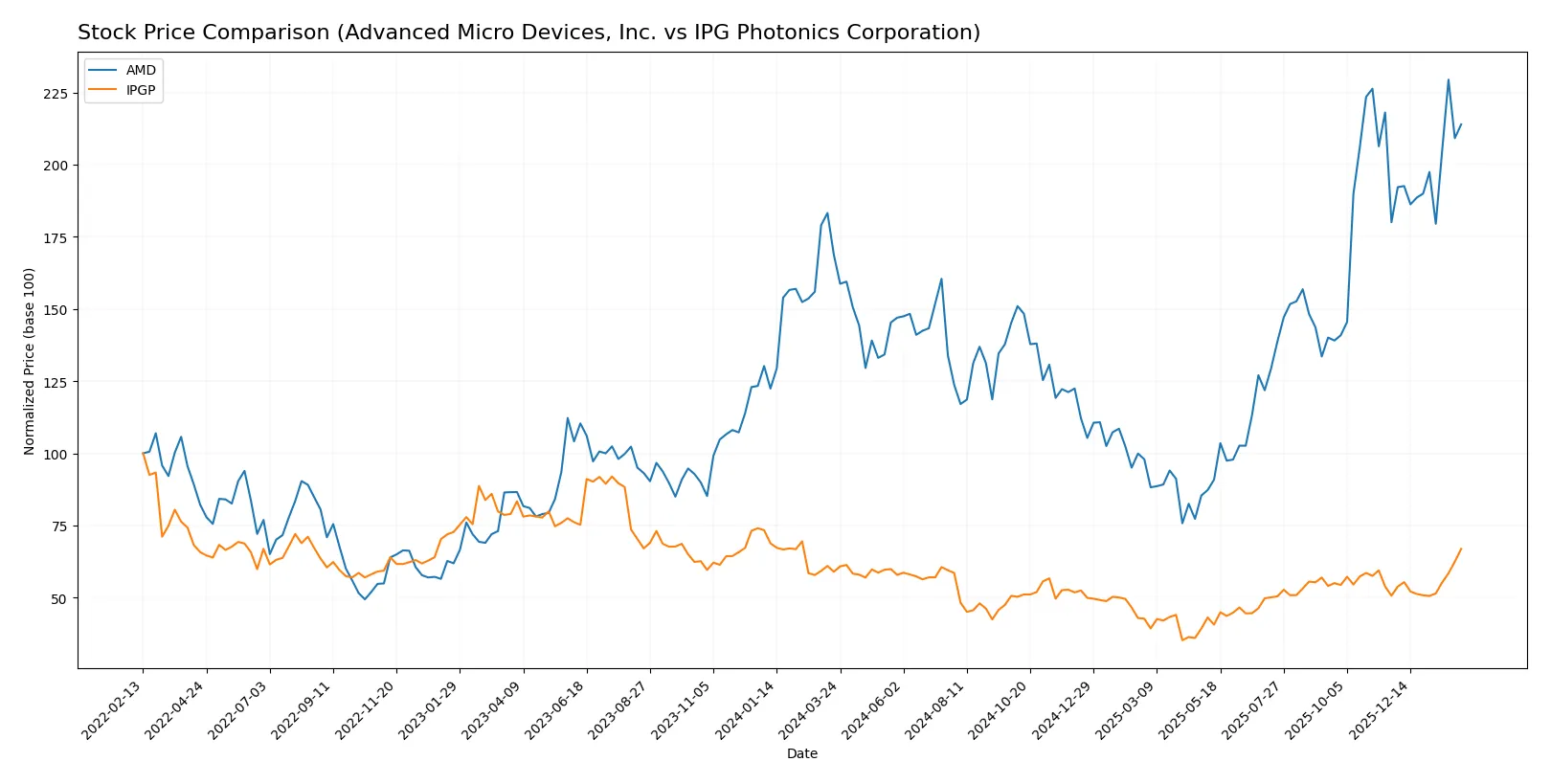
Trend Comparison
Advanced Micro Devices, Inc. (AMD) exhibits a bullish trend with a 26.72% price increase over the last 12 months. The trend accelerates, reaching a high of 259.68 and a low of 85.76.
IPG Photonics Corporation (IPGP) also shows a bullish trend, gaining 13.39% in the same period. The price trend accelerates, hitting a high of 98.92 and a low of 52.12.
AMD outperformed IPGP with higher overall returns and stronger acceleration, delivering the highest market performance over the past year.
Target Prices
Analysts present a cautiously optimistic consensus for these semiconductor stocks.
| Company | Target Low | Target High | Consensus |
|---|---|---|---|
| Advanced Micro Devices, Inc. | 225 | 380 | 291.56 |
| IPG Photonics Corporation | 92 | 110 | 101 |
The consensus targets for AMD and IPGP imply upside potential of roughly 20% and 2% respectively versus current prices. This signals moderate bullishness for AMD and a near-neutral outlook for IPGP.

Don’t Let Luck Decide Your Entry Point
Optimize your entry points with our advanced ProRealTime indicators. You’ll get efficient buy signals with precise price targets for maximum performance. Start outperforming now!
How do institutions grade them?
The following tables summarize recent institutional grades for Advanced Micro Devices, Inc. and IPG Photonics Corporation:
Advanced Micro Devices, Inc. Grades
This table shows recent grades and actions from well-known grading companies for AMD.
| Grading Company | Action | New Grade | Date |
|---|---|---|---|
| Wells Fargo | Maintain | Overweight | 2026-01-30 |
| Piper Sandler | Maintain | Overweight | 2026-01-26 |
| UBS | Maintain | Buy | 2026-01-26 |
| Bernstein | Maintain | Market Perform | 2026-01-21 |
| Keybanc | Upgrade | Overweight | 2026-01-13 |
| Truist Securities | Maintain | Buy | 2025-12-19 |
| Cantor Fitzgerald | Maintain | Overweight | 2025-12-16 |
| Morgan Stanley | Maintain | Equal Weight | 2025-11-12 |
| Wedbush | Maintain | Outperform | 2025-11-12 |
| Rosenblatt | Maintain | Buy | 2025-11-12 |
IPG Photonics Corporation Grades
This table details recent grades and rating changes from recognized grading firms for IPGP.
| Grading Company | Action | New Grade | Date |
|---|---|---|---|
| Citigroup | Upgrade | Buy | 2025-11-05 |
| Bernstein | Upgrade | Outperform | 2025-08-07 |
| Raymond James | Maintain | Strong Buy | 2025-05-07 |
| CL King | Upgrade | Buy | 2025-03-18 |
| Citigroup | Maintain | Sell | 2025-02-18 |
| Stifel | Maintain | Buy | 2025-02-12 |
| Needham | Maintain | Hold | 2025-02-12 |
| Seaport Global | Downgrade | Neutral | 2024-08-01 |
| Stifel | Maintain | Buy | 2024-07-31 |
| Raymond James | Maintain | Strong Buy | 2024-07-31 |
Which company has the best grades?
AMD consistently receives mainly Overweight and Buy ratings from major firms, signaling stable confidence. IPGP shows a wider range, including Strong Buy and Outperform but also some Sell grades. Investors may weigh AMD’s steadier outlook against IPGP’s mixed signals.
Risks specific to each company
The following categories identify the critical pressure points and systemic threats facing both firms in the 2026 market environment:
1. Market & Competition
Advanced Micro Devices, Inc.
- Faces intense competition in semiconductors with rapid innovation cycles and margin pressure.
IPG Photonics Corporation
- Operates in niche laser market but faces competition from emerging laser technologies and substitutes.
2. Capital Structure & Debt
Advanced Micro Devices, Inc.
- Maintains a favorable debt profile with strong interest coverage, indicating financial stability.
IPG Photonics Corporation
- Exhibits very low debt and strong coverage, minimizing financial risk.
3. Stock Volatility
Advanced Micro Devices, Inc.
- High beta (~1.95) signals elevated stock volatility and sensitivity to market swings.
IPG Photonics Corporation
- Moderate beta (~1.03) suggests relatively lower volatility and steadier price movements.
4. Regulatory & Legal
Advanced Micro Devices, Inc.
- Subject to global semiconductor export controls and IP litigation risks.
IPG Photonics Corporation
- Faces regulatory scrutiny in fiber laser applications and export restrictions, but less intense than AMD.
5. Supply Chain & Operations
Advanced Micro Devices, Inc.
- Vulnerable to semiconductor supply chain disruptions and raw material price swings.
IPG Photonics Corporation
- Dependent on specialized components but benefits from more stable supply chains in lasers.
6. ESG & Climate Transition
Advanced Micro Devices, Inc.
- Increasing pressure to reduce carbon footprint in manufacturing and align with ESG standards.
IPG Photonics Corporation
- Faces ESG risks related to energy-intensive laser production but opportunities in clean tech applications.
7. Geopolitical Exposure
Advanced Micro Devices, Inc.
- High exposure to US-China tensions affecting chip exports and global sales.
IPG Photonics Corporation
- Limited geopolitical risk due to more diversified and specialized market focus.
Which company shows a better risk-adjusted profile?
The most impactful risk for AMD is its high stock volatility coupled with geopolitical exposure, threatening earnings stability. IPG’s greatest risk lies in its negative profitability metrics, highlighting operational challenges. Despite these issues, IPG displays a stronger capital structure and lower volatility. I find IPG offers a better risk-adjusted profile, supported by its safe-zone Altman Z-Score and solid Piotroski score, contrasting AMD’s unfavorable ROIC and WACC.
Final Verdict: Which stock to choose?
Advanced Micro Devices (AMD) excels as a powerhouse in innovation and revenue growth, driven by unmatched R&D intensity and strong market demand. Its main point of vigilance is the declining return on invested capital, signaling potential challenges in sustaining profitability. AMD fits an Aggressive Growth portfolio focused on capturing market share and technological advancement.
IPG Photonics (IPGP) boasts a strategic moat with its niche in high-precision photonics technology and solid recurring cash flow, supported by a robust balance sheet and conservative debt levels. Despite recent profitability setbacks, it offers better stability compared to AMD. IPGP suits a GARP (Growth at a Reasonable Price) portfolio seeking steady, defensible niche plays.
If you prioritize rapid innovation and top-line expansion, AMD is the compelling choice due to its market leadership and growth trajectory despite profitability headwinds. However, if you seek resilience and capital preservation within a specialized tech segment, IPGP offers better stability and a safer financial footing, albeit with slower growth prospects.
Disclaimer: Investment carries a risk of loss of initial capital. The past performance is not a reliable indicator of future results. Be sure to understand risks before making an investment decision.
Go Further
I encourage you to read the complete analyses of Advanced Micro Devices, Inc. and IPG Photonics Corporation to enhance your investment decisions: