Home > Comparison > Technology > ACN vs DXC
The strategic rivalry between Accenture plc and DXC Technology Company shapes the trajectory of the global technology services sector. Accenture operates as a high-margin consulting and digital transformation powerhouse, while DXC focuses on IT outsourcing and infrastructure services. This head-to-head reflects a battle between innovation-led growth and operational efficiency. This analysis will clarify which company’s strategy delivers superior risk-adjusted returns for a diversified portfolio in today’s evolving tech landscape.

Table of contents
Companies Overview
Accenture plc and DXC Technology Company are pivotal players in the global information technology services market. Both firms shape digital transformation across diverse industries with distinct scale and strategic approaches.
Accenture plc: Global IT Services Powerhouse
Accenture dominates as a professional services company offering strategy, consulting, and technology operations worldwide. Its revenue stems from agile transformation, cloud services, and intelligent automation. In 2026, Accenture focuses on expanding digital industrial workforce solutions and AI-driven consulting to maintain its competitive edge in innovation.
DXC Technology Company: IT Services Specialist
DXC Technology delivers IT services primarily across North America, Europe, Asia, and Australia. Its core revenues arise from Global Business Services and Global Infrastructure Services, emphasizing analytics, cloud migration, and cybersecurity. In 2026, DXC prioritizes secure multi-cloud management and agile process automation to enhance client digital transformations.
Strategic Collision: Similarities & Divergences
Accenture pursues a broad, innovation-led ecosystem approach, while DXC emphasizes specialized, secure infrastructure services. Their primary battleground lies in digital transformation advisory and cloud enablement. Accenture’s vast scale and global footprint contrast with DXC’s focused service portfolio, defining their distinct investment profiles in market reach and strategic depth.
Income Statement Comparison
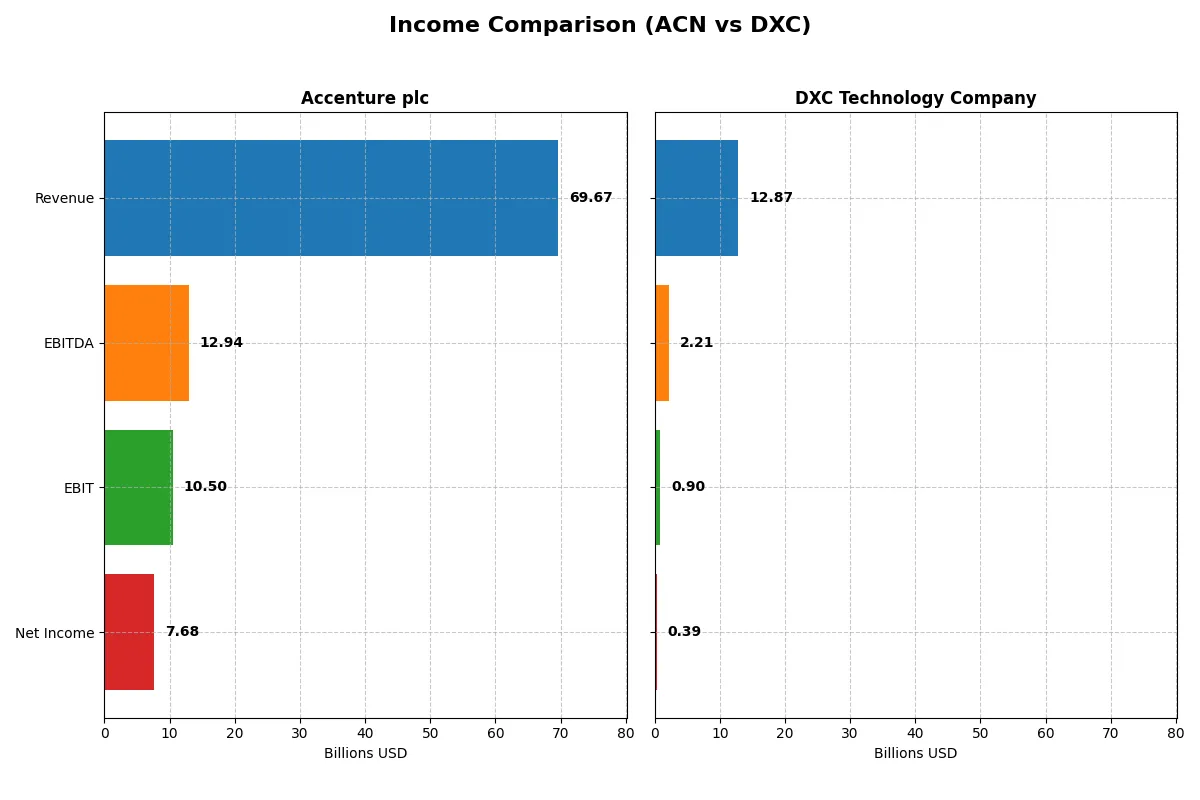
This data dissects the core profitability and scalability of both corporate engines to reveal who dominates the bottom line:
| Metric | Accenture plc (ACN) | DXC Technology Company (DXC) |
|---|---|---|
| Revenue | 69.7B | 12.9B |
| Cost of Revenue | 47.4B | 9.8B |
| Operating Expenses | 12.0B | 2.4B |
| Gross Profit | 22.2B | 3.1B |
| EBITDA | 12.9B | 2.2B |
| EBIT | 10.5B | 895M |
| Interest Expense | 229M | 265M |
| Net Income | 7.7B | 389M |
| EPS | 12.29 | 2.15 |
| Fiscal Year | 2025 | 2025 |
Income Statement Analysis: The Bottom-Line Duel
This income statement comparison reveals which company converts revenue into profit with the greatest efficiency and momentum.
Accenture plc Analysis
Accenture’s revenue grew steadily from 50.5B in 2021 to 69.7B in 2025, with net income rising from 5.9B to 7.7B. Gross margins remain strong near 32%, and net margins hold above 11%. In 2025, Accenture sustained margin health while expanding revenues, signaling robust operational efficiency and consistent earnings momentum.
DXC Technology Company Analysis
DXC’s revenue declined from 16.3B in 2021 to 12.9B in 2025, with net income swinging from a 568M loss in 2023 to a 389M profit in 2025. Gross margin hovers around 24%, while net margin sits low at 3%. Despite recent margin improvement and a sharp earnings rebound, DXC’s shrinking top line points to structural challenges and recovery in progress.
Margin Strength vs. Revenue Growth
Accenture dominates with superior revenue scale and stable, high margins, delivering consistent profit expansion. DXC shows margin recovery and positive earnings growth but struggles with a declining revenue base. For investors, Accenture’s profile offers dependable growth and margin resilience, while DXC reflects a turnaround story with higher execution risk.
Financial Ratios Comparison
These vital ratios act as a diagnostic tool to expose the underlying fiscal health, valuation premiums, and capital efficiency of the companies compared:
| Ratios | Accenture plc (ACN) | DXC Technology Company (DXC) |
|---|---|---|
| ROE | 24.6% | 12.0% |
| ROIC | 17.0% | 4.4% |
| P/E | 21.2 | 7.9 |
| P/B | 5.21 | 0.95 |
| Current Ratio | 1.42 | 1.22 |
| Quick Ratio | 1.42 | 1.22 |
| D/E | 0.26 | 1.41 |
| Debt-to-Assets | 12.5% | 34.4% |
| Interest Coverage | 44.7 | 2.63 |
| Asset Turnover | 1.07 | 0.97 |
| Fixed Asset Turnover | 16.2 | 6.82 |
| Payout ratio | 48.2% | 0% |
| Dividend yield | 2.28% | 0% |
| Fiscal Year | 2025 | 2025 |
Efficiency & Valuation Duel: The Vital Signs
Financial ratios act as a company’s DNA, uncovering hidden risks and operational strengths vital to investors’ decisions.
Accenture plc
Accenture demonstrates robust profitability with a 24.61% ROE and an 11.02% net margin, signaling operational efficiency. Its P/E of 21.16 is fairly valued but a high P/B at 5.21 suggests some premium pricing. The company delivers shareholder returns via a 2.28% dividend yield, reflecting steady cash flow and capital discipline.
DXC Technology Company
DXC operates with weaker profitability, posting a 12.05% ROE and a 3.02% net margin, indicating operational challenges. Its low P/E of 7.92 and P/B of 0.95 suggest undervaluation. However, the absence of dividends and high debt-to-equity ratio of 1.41 highlight financial leverage risks, tempering its value appeal.
Premium Valuation vs. Operational Safety
Accenture offers a superior balance of profitability and shareholder returns despite a stretched P/B ratio. DXC’s cheaper valuation comes with significant leverage and margin concerns. Investors prioritizing stability and consistent returns may favor Accenture, while value seekers might consider DXC’s riskier profile.
Which one offers the Superior Shareholder Reward?
I compare Accenture plc (ACN) and DXC Technology Company (DXC) on shareholder rewards through dividends and buybacks. ACN yields 2.28% with a 48% payout ratio, comfortably covered by free cash flow of $17.4/share. It sustains buybacks, fueling total returns. DXC pays no dividend and reinvests earnings amid narrow 3% net margin and heavy debt (D/E 1.41). Its buyback program is minimal and fragile. Historically in IT services, balanced dividends plus buybacks drive durable value. I see ACN’s disciplined cash returns and strong margins as superior. For 2026, ACN offers the more attractive total return profile given its sustainable, shareholder-friendly capital allocation.
Comparative Score Analysis: The Strategic Profile
The radar chart exposes the fundamental DNA and trade-offs of Accenture plc and DXC Technology Company side by side:
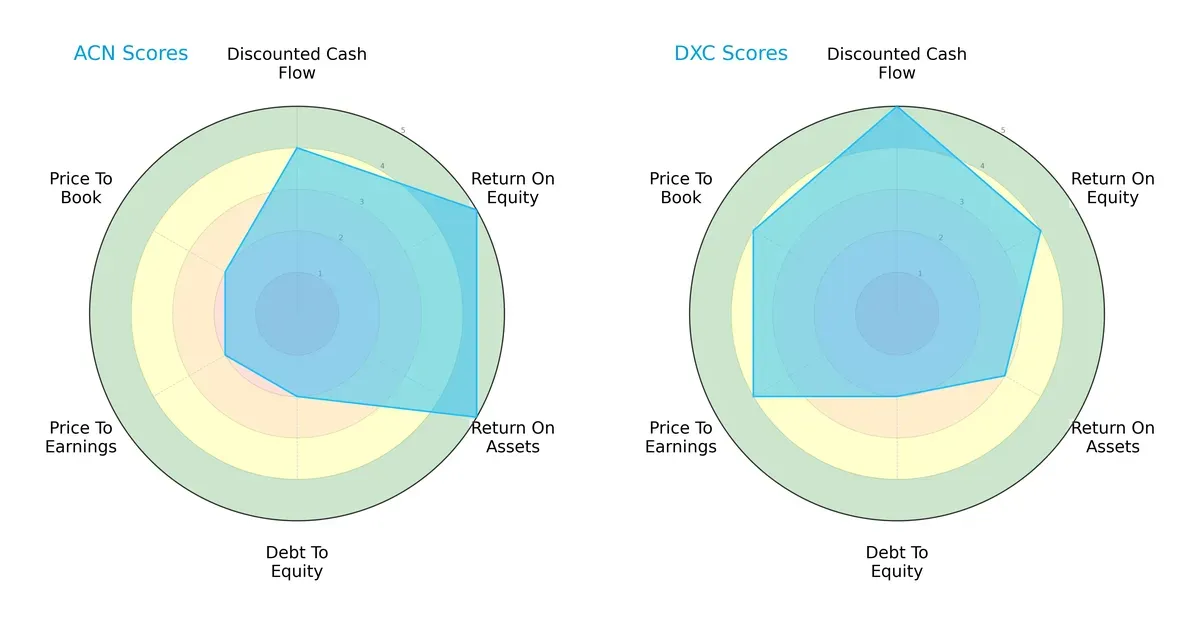
Accenture shows strength in profitability with very favorable ROE and ROA scores (5 each), but its valuation metrics (P/E and P/B at 2) suggest moderate market optimism. DXC excels in discounted cash flow (5) and valuation (P/E and P/B at 4), signaling market confidence, yet lags in asset efficiency (ROA at 3). Accenture presents a more balanced profile focused on operational excellence, while DXC leverages its valuation appeal but relies more heavily on cash flow advantages.
Bankruptcy Risk: Solvency Showdown
Accenture’s Altman Z-Score of 5.45 firmly places it in the safe zone, while DXC’s 1.17 sits in the distress zone, implying a stark contrast in long-term solvency and bankruptcy risk:
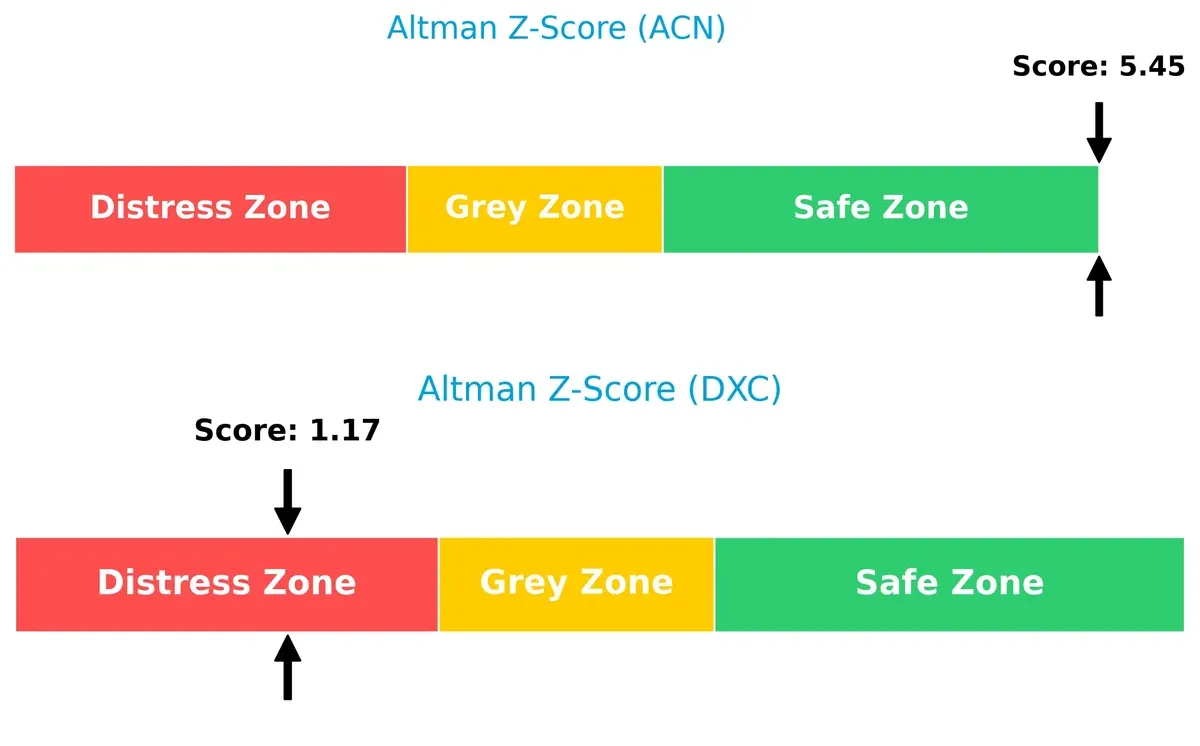
Accenture stands out as a financially stable firm unlikely to face distress in this cycle. DXC’s score warns investors of higher bankruptcy risk, requiring cautious portfolio weighting.
Financial Health: Quality of Operations
DXC scores a strong 7 on the Piotroski F-Score, surpassing Accenture’s average 6, signaling superior internal financial health and operational quality:
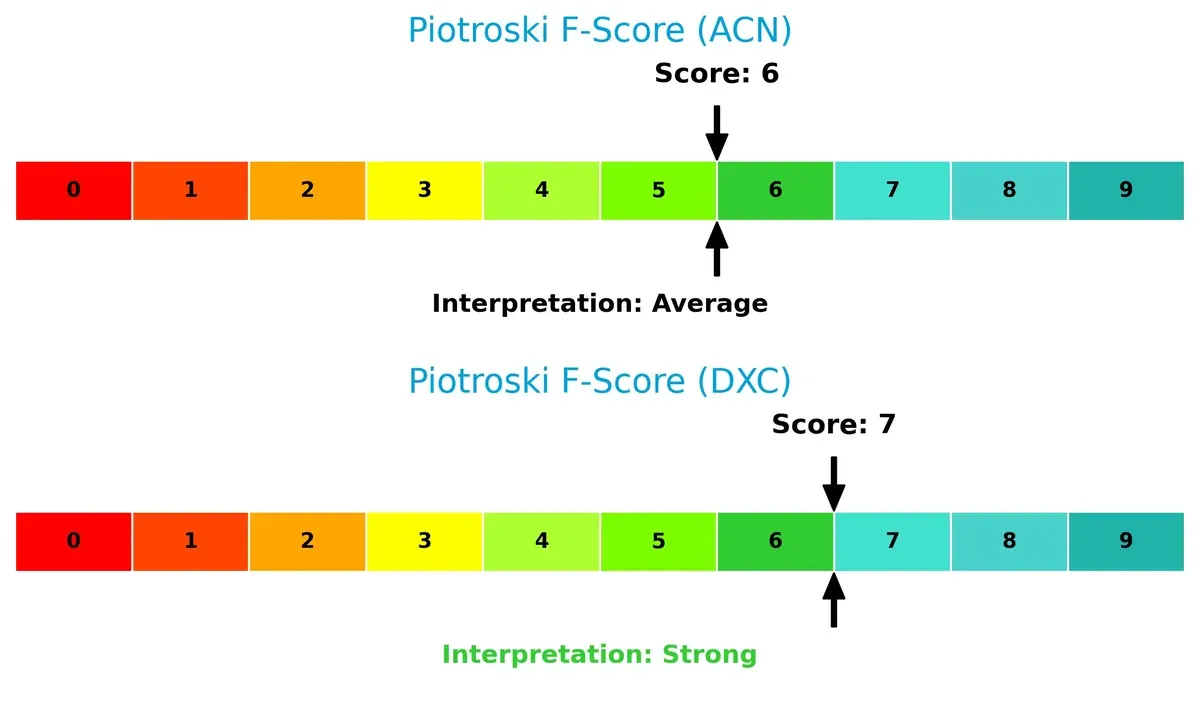
DXC’s higher Piotroski score reveals fewer red flags in profitability, leverage, and efficiency metrics. Accenture’s slightly lower score suggests moderate concerns to monitor, despite its robust external ratings.
How are the two companies positioned?
This section dissects the operational DNA of Accenture and DXC by comparing their revenue distribution by segment and internal dynamics. The goal is to confront their economic moats and identify which model offers the most resilient, sustainable competitive advantage today.
Revenue Segmentation: The Strategic Mix
This comparison dissects how Accenture plc and DXC Technology Company diversify their income streams and where their primary sector bets lie:
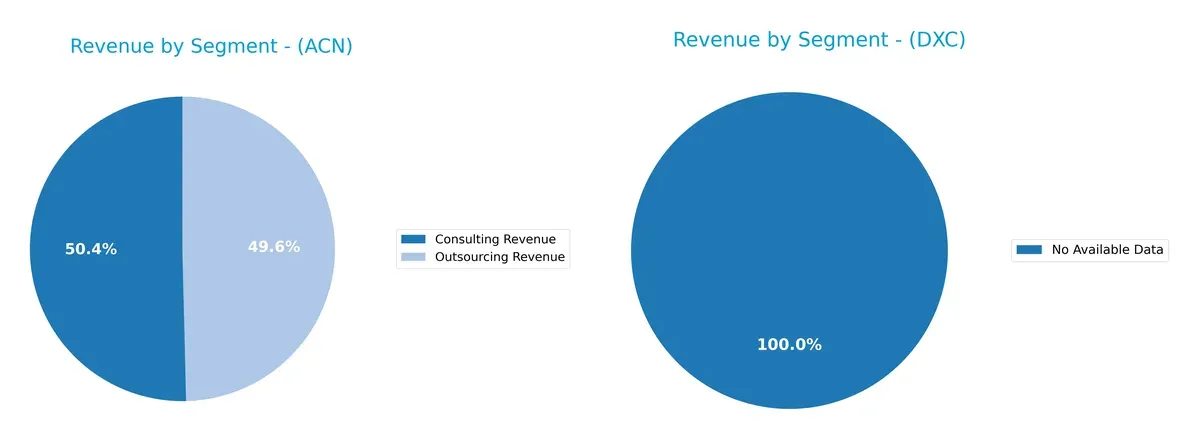
Accenture pivots on two dominant streams: Consulting at $35.1B and Outsourcing near $34.6B in 2025. This near-equal split shows robust diversification within professional services. DXC Technology lacks available segment data, preventing direct comparison. Accenture’s balance reduces concentration risk and strengthens ecosystem lock-in through broad service offerings. This strategy contrasts sharply with single-segment reliance, which can expose firms to cyclical downturns or disruptive innovation.
Strengths and Weaknesses Comparison
This table compares the Strengths and Weaknesses of Accenture plc and DXC Technology Company:
Accenture plc Strengths
- Strong profitability with 11.02% net margin and 24.61% ROE
- High ROIC of 16.99% exceeding WACC
- Diversified revenue streams including consulting and outsourcing
- Solid global presence across North America, Europe, and growth markets
- Favorable asset turnover ratios
- Consistent dividend yield of 2.28%
DXC Technology Company Strengths
- Favorable valuation metrics with PE of 7.92 and PB of 0.95
- Positive quick ratio indicating liquidity
- Lower WACC at 5.69% supports efficient capital cost
- Favorable fixed asset turnover at 6.82
- Neutral interest coverage suggests manageable debt costs
Accenture plc Weaknesses
- High PB ratio of 5.21 signals potential overvaluation
- Neutral current ratio indicates moderate short-term liquidity
- Heavy reliance on consulting and outsourcing segments may limit flexibility
DXC Technology Company Weaknesses
- Low net margin of 3.02% and ROIC of 4.43% show weak profitability
- High debt-to-equity ratio of 1.41 raises financial risk
- No dividend yield reduces investor income appeal
- Neutral to unfavorable asset turnover and interest coverage metrics
Accenture’s strengths center on robust profitability and diversified global operations, though valuation may be a concern. DXC shows strengths in valuation and capital cost but faces profitability and leverage challenges, affecting its financial stability.
The Moat Duel: Analyzing Competitive Defensibility
A structural moat is the only reliable shield protecting long-term profits from relentless competitive erosion in dynamic markets:
Accenture plc: Intangible Assets and Ecosystem Dominance
I see Accenture’s moat rooted in deep intangible assets and a vast partner ecosystem. Its 7.6% ROIC premium over WACC signals value creation. Margin stability supports robust pricing power. New digital transformation services in AI and cloud promise to widen this moat in 2026.
DXC Technology Company: Cost Advantage Under Pressure
DXC leans on cost efficiencies within legacy IT services, contrasting Accenture’s innovation edge. Yet, its negative ROIC spread reveals value destruction. While recent margin improvement signals operational tightening, declining revenue trends question future moat durability. DXC’s expansion into cloud security may slow erosion but faces stiff competition.
Intangible Assets vs. Cost Efficiency: Who Holds the Stronger Defensive Line?
Accenture’s intangible asset moat is wider and deeper, supported by consistent value creation and margin resilience. DXC’s cost advantage is weaker, with negative returns and shrinking revenue. Accenture stands better equipped to defend and grow its market share in 2026.
Which stock offers better returns?
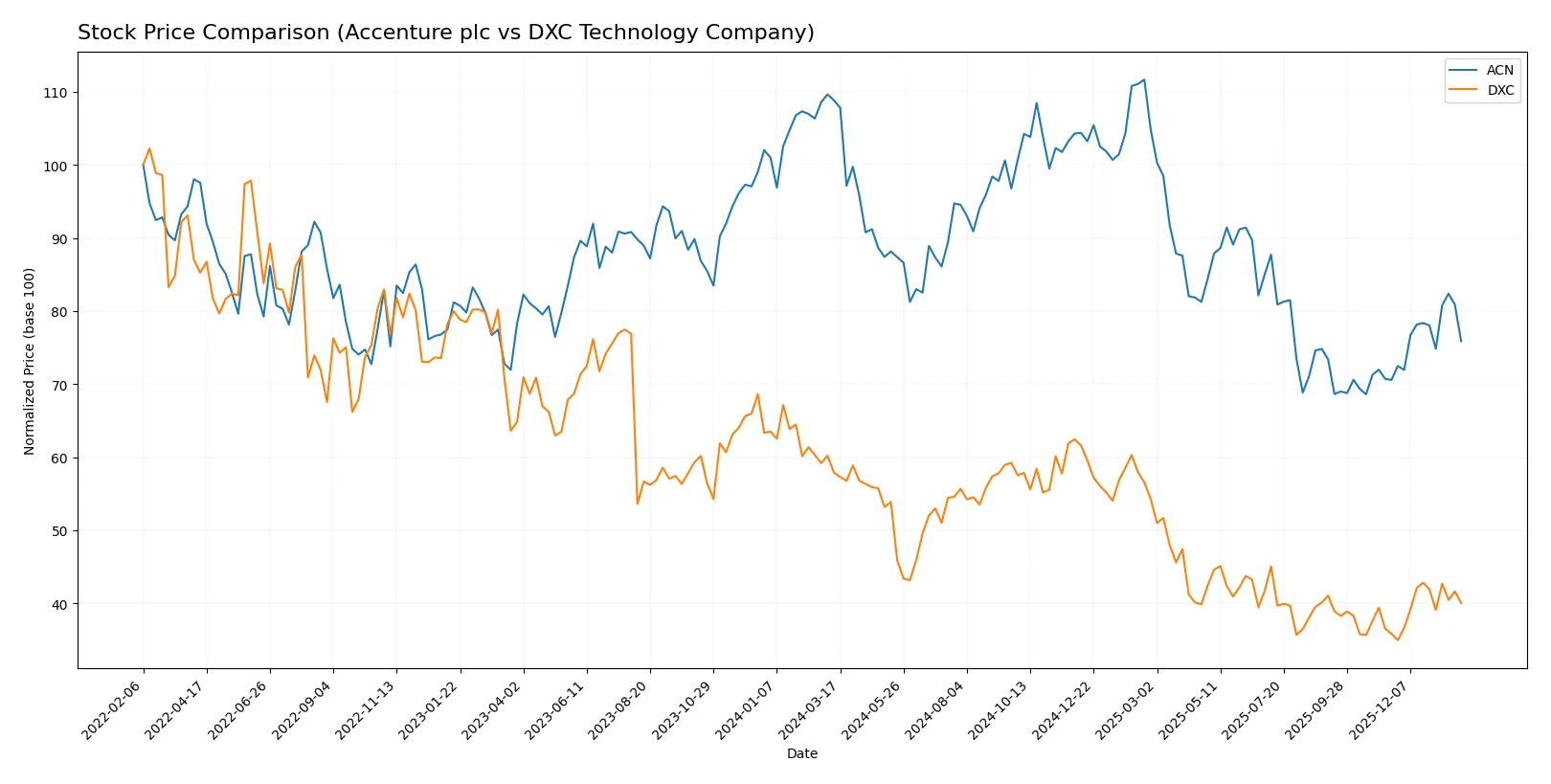
Both Accenture plc and DXC Technology Company experienced significant price declines over the past year, followed by recent upward trends indicating potential recovery phases.
Trend Comparison
Accenture plc’s stock fell 30.29% over the past year, marking a bearish trend with accelerating decline and high volatility. Recent months show a 7.52% rebound with increased buyer dominance.
DXC Technology Company’s stock also dropped 30.82% during the year, displaying a bearish trend with accelerating losses but lower volatility. Its recent 11.77% gain reflects a modest recovery amid slightly buyer-dominant trading.
Both stocks faced similar annual declines, but DXC’s recent stronger rebound outpaced Accenture’s recovery, delivering higher short-term market performance.
Target Prices
Analysts present a cautiously optimistic consensus for Accenture plc and DXC Technology Company.
| Company | Target Low | Target High | Consensus |
|---|---|---|---|
| Accenture plc | 265 | 330 | 302.93 |
| DXC Technology Company | 13 | 14 | 13.5 |
Accenture’s target consensus exceeds its current price of 264, signaling upside potential. DXC’s consensus is slightly below its 14.43 market price, suggesting limited near-term gains.

Don’t Let Luck Decide Your Entry Point
Optimize your entry points with our advanced ProRealTime indicators. You’ll get efficient buy signals with precise price targets for maximum performance. Start outperforming now!
How do institutions grade them?
Here is a summary of institutional grades for Accenture plc and DXC Technology Company:
Accenture plc Grades
The table below shows recent institutional grades for Accenture plc:
| Grading Company | Action | New Grade | Date |
|---|---|---|---|
| Wells Fargo | Maintain | Equal Weight | 2026-01-14 |
| UBS | Maintain | Buy | 2025-12-19 |
| Susquehanna | Maintain | Neutral | 2025-12-19 |
| RBC Capital | Maintain | Outperform | 2025-12-19 |
| Morgan Stanley | Upgrade | Overweight | 2025-12-16 |
| Mizuho | Maintain | Outperform | 2025-09-29 |
| Evercore ISI Group | Maintain | Outperform | 2025-09-26 |
| BMO Capital | Maintain | Market Perform | 2025-09-26 |
| TD Cowen | Maintain | Buy | 2025-09-26 |
| Goldman Sachs | Maintain | Buy | 2025-09-26 |
DXC Technology Company Grades
The table below shows recent institutional grades for DXC Technology Company:
| Grading Company | Action | New Grade | Date |
|---|---|---|---|
| Stifel | Maintain | Hold | 2025-10-31 |
| JP Morgan | Maintain | Underweight | 2025-08-20 |
| RBC Capital | Maintain | Sector Perform | 2025-08-01 |
| Morgan Stanley | Maintain | Equal Weight | 2025-08-01 |
| JP Morgan | Maintain | Underweight | 2025-05-21 |
| RBC Capital | Maintain | Sector Perform | 2025-05-15 |
| BMO Capital | Maintain | Market Perform | 2025-05-15 |
| Morgan Stanley | Maintain | Equal Weight | 2025-05-15 |
| Guggenheim | Maintain | Neutral | 2025-05-12 |
| Susquehanna | Maintain | Neutral | 2025-04-23 |
Which company has the best grades?
Accenture consistently receives higher grades, including multiple “Buy” and “Outperform” ratings and an upgrade to “Overweight.” DXC’s grades cluster around “Hold,” “Neutral,” and “Underweight.” Investors may view Accenture as having stronger institutional support.
Risks specific to each company
The following categories highlight critical pressure points and systemic threats facing Accenture plc and DXC Technology Company in the 2026 market environment:
1. Market & Competition
Accenture plc
- Dominates with global scale and innovation in digital transformation services.
DXC Technology Company
- Faces intense competition and struggles to differentiate in traditional IT outsourcing.
2. Capital Structure & Debt
Accenture plc
- Maintains low debt-to-equity (0.26), signaling financial prudence.
DXC Technology Company
- High debt-to-equity ratio (1.41) increases financial risk and interest burden.
3. Stock Volatility
Accenture plc
- Beta of 1.25 indicates moderate sensitivity to market swings.
DXC Technology Company
- Lower beta of 1.05 implies relative stability but less growth momentum.
4. Regulatory & Legal
Accenture plc
- Operates globally with complex compliance demands, but strong governance.
DXC Technology Company
- Exposure to regulatory scrutiny in North America and Europe adds legal risks.
5. Supply Chain & Operations
Accenture plc
- Robust global delivery network supports operational resilience.
DXC Technology Company
- Legacy systems and slower cloud migration weigh on operational efficiency.
6. ESG & Climate Transition
Accenture plc
- Progressive sustainability initiatives enhance brand and investor appeal.
DXC Technology Company
- ESG efforts less mature, potentially risking stakeholder confidence.
7. Geopolitical Exposure
Accenture plc
- Diversified global footprint mitigates regional geopolitical shocks.
DXC Technology Company
- Concentrated presence in US and Europe raises exposure to trade and political risks.
Which company shows a better risk-adjusted profile?
Accenture’s strongest risk is competitive pressure to innovate and maintain leadership amid tech disruptions. DXC’s critical risk is its leveraged balance sheet and operational drag from legacy IT. I see Accenture presenting a superior risk-adjusted profile, supported by its robust Altman Z-score (5.45, safe zone) versus DXC’s distressed score (1.17). The data shows DXC’s high debt and low margin create vulnerability despite its value metrics, underscoring my cautious stance on its financial stability.
Final Verdict: Which stock to choose?
Accenture plc’s superpower lies in its ability to generate strong returns on invested capital, consistently creating value despite a modest decline in profitability. Its robust financial health and operational efficiency make it a solid pick for portfolios seeking steady, long-term growth with moderate risk. A point of vigilance remains its premium valuation multiples.
DXC Technology’s strategic moat is its attractive valuation combined with a favorable cost of capital, providing potential upside for value-driven investors. While it shows signs of financial distress and weaker profitability compared to Accenture, its low price-to-earnings and price-to-book ratios offer a margin of safety. This stock fits well in a contrarian or value-focused portfolio.
If you prioritize consistent value creation and operational excellence, Accenture outshines with superior capital efficiency and earnings quality. However, if you seek deep value opportunities with a willingness to tolerate higher risk, DXC offers better stability in valuation and potential for turnaround gains. Each choice aligns with distinct investor profiles and risk appetites.
Disclaimer: Investment carries a risk of loss of initial capital. The past performance is not a reliable indicator of future results. Be sure to understand risks before making an investment decision.
Go Further
I encourage you to read the complete analyses of Accenture plc and DXC Technology Company to enhance your investment decisions: